Compounded Medications vs Traditional Pharmacy Medications: What’s the Difference?
Why Personalized Formulas Offer Unique Advantages Over Standard, Mass-Produced Drugs
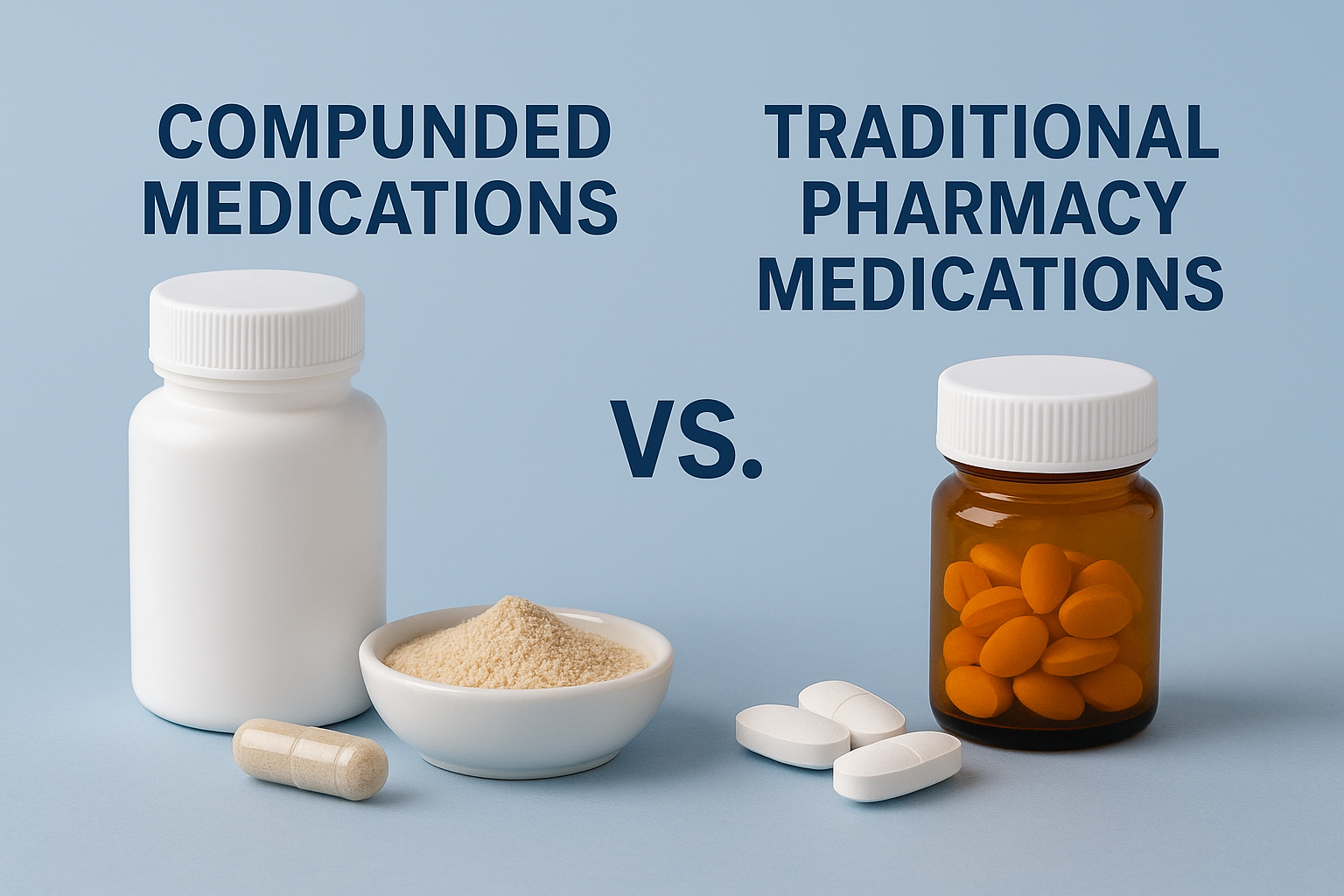
When you receive a prescription, you typically take it to a traditional retail pharmacy where a pre-manufactured, FDA-approved drug is dispensed. This system works well for most patients.
However, a specialized compounding pharmacy offers an entirely different, patient-centric solution. Rather than dispensing mass-produced medicine, compounding pharmacists act as drug preparers, creating custom formulas from scratch.
Understanding the differences between compounded medications and traditional pharmacy medications is essential for patients seeking the most precise and effective treatment.
1. Dosing and Strength
The primary difference lies in the level of customization available.
2. Dosage Form and Administration
Traditional medicine is often limited to tablets, capsules, and standard liquids. Compounding overcomes this barrier by changing the physical form of the medication.
-
Compounded Advantage: A drug can be transformed into a transdermal cream, a flavored oral suspension for children, a rapid-dissolving troche, or an injectable solution. This is critical for patients who struggle with swallowing pills or who require localized treatment (e.g., pain creams).
-
Traditional Limitation: If a patient cannot swallow a pill, there are few or no alternatives available from manufacturers.
3. Ingredients and Safety
Both types of medication rely on high-quality active ingredients, but they differ significantly in their inactive components.
-
Compounded Safety: Pharmacists can formulate medications that are free of common allergens like lactose, gluten, dyes, sugars, and preservatives. This is vital for patients with multiple sensitivities or severe allergies, ensuring they only receive the therapeutic agents they need.
-
Traditional Ingredients: Commercial drugs contain a standard mix of inactive binders, fillers, and dyes, which are unnecessary for treatment but can trigger adverse reactions in sensitive individuals.
4. Quality Control and Regulation
Both compounding and dispensing are highly regulated, but the nature of the oversight differs.
Traditional Medication: FDA Approval
Commercial drugs undergo a multi-year FDA approval process to prove the drug is safe and effective for its intended use. The FDA monitors the manufacturing facility and sets standards for the finished product.
Compounded Medication: State Board & Third-Party Accreditation
Compounded medications are prepared under the direct supervision of a licensed pharmacist based on a patient-specific prescription. They are not FDA-approved because they are not mass-manufactured.
Therefore, quality is maintained by adherence to strict standards set by the USP (United States Pharmacopeia), covering facility cleanliness, training, and testing.
Crucially, safety is verified by third-party accreditors like LegitScript. Vivmeds is LegitScript-certified, confirming that our practices meet the highest standards for compounding safety and legitimacy, especially for complex medications like injectables.
5. Cost and Availability
The cost and availability models reflect the production method.
Conclusion: Which Option Is Right for You?
The choice between a compounded medication and a traditional one is dictated entirely by your unique medical needs, as determined by your healthcare provider.
-
If a standard, mass-produced dose works for you without side effects or allergies, a traditional pharmacy is the right choice.
-
If you need a specific dose, an alternative delivery method, or an allergen-free formula, or if you are pursuing specialized treatments like personalized Weight Loss or Hormone Care, a custom compound is necessary.
Vivmeds Pharmacy bridges the gap between patient needs and pharmaceutical science, ensuring that every patient receives the precise, high-quality medication prescribed for their optimal health outcome.
Consult Vivmeds Pharmacy Today to find out if personalized compounded medication is the right solution for your treatment plan.